
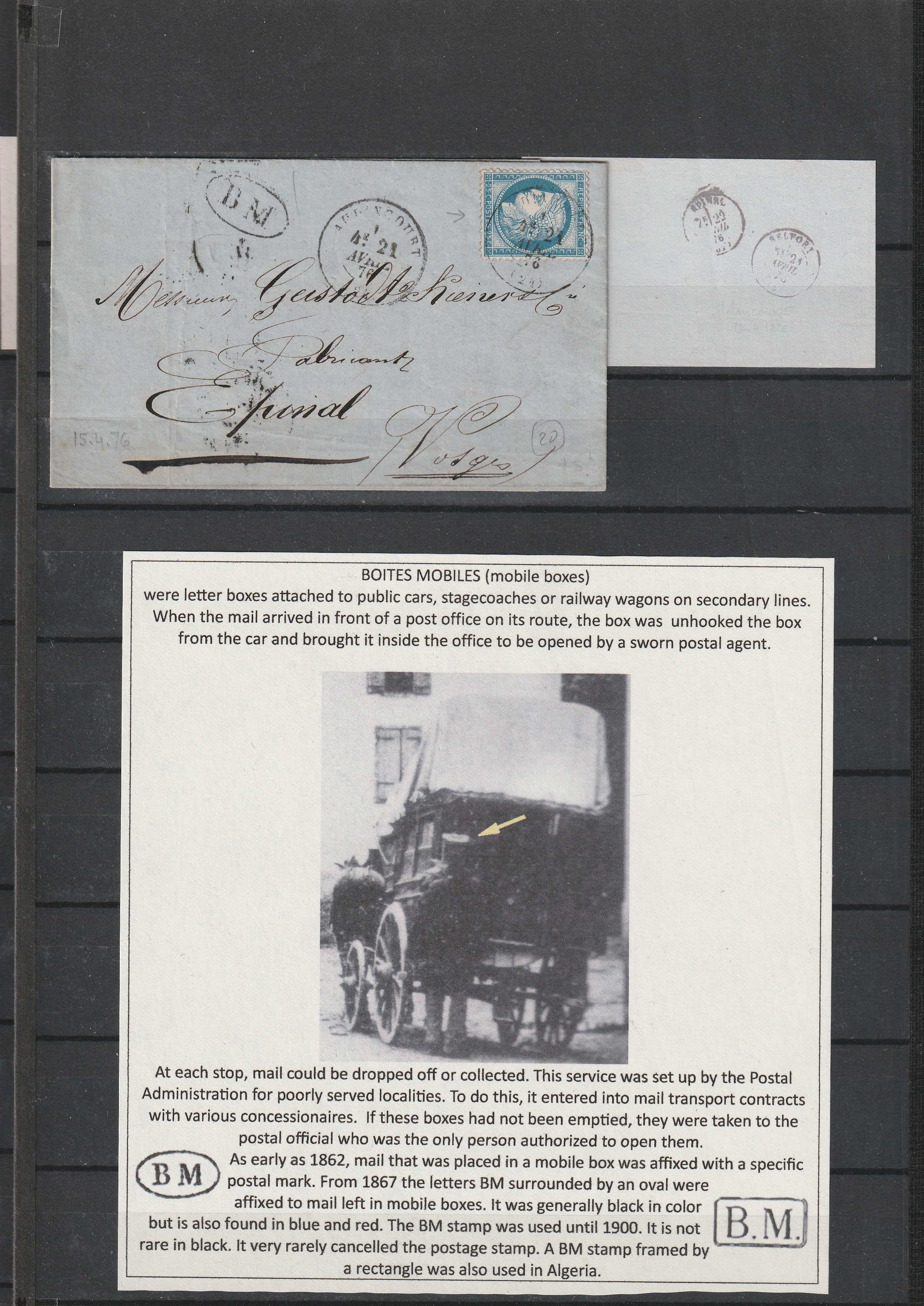
BOITES MOBILES (mobile boxes)
were letter boxes attached to public cars, stagecoaches or railway wagons on secondary lines.
When the mail arrived in front of a post office on its route, the box was unhooked the box
from the car and brought it inside the office to be opened by a sworn postal agent.
At each stop, mail could be dropped off or collected. This service was set up by the Postal
Administration for poorly served localities. To do this, it entered into mail transport contracts
with various concessionaires. If these boxes had not been emptied, they were taken to the
postal official who was the only person authorized to open them.
As early as 1862, mail that was placed in a mobile box was affixed with a specific
postal mark. From 1867 the letters BM surrounded by an oval were
affixed to mail left in mobile boxes. It was generally black in color
but is also found in blue and red. The BM stamp was used until 1900. It is not rare in black. It very rarely cancelled the postage stamp. A BM stamp framed by
a rectangle was also used in Algeria.
Bonmal Lamourade & Cie 19e 5
à NIMES
DRESST
BR GUIN
(281)
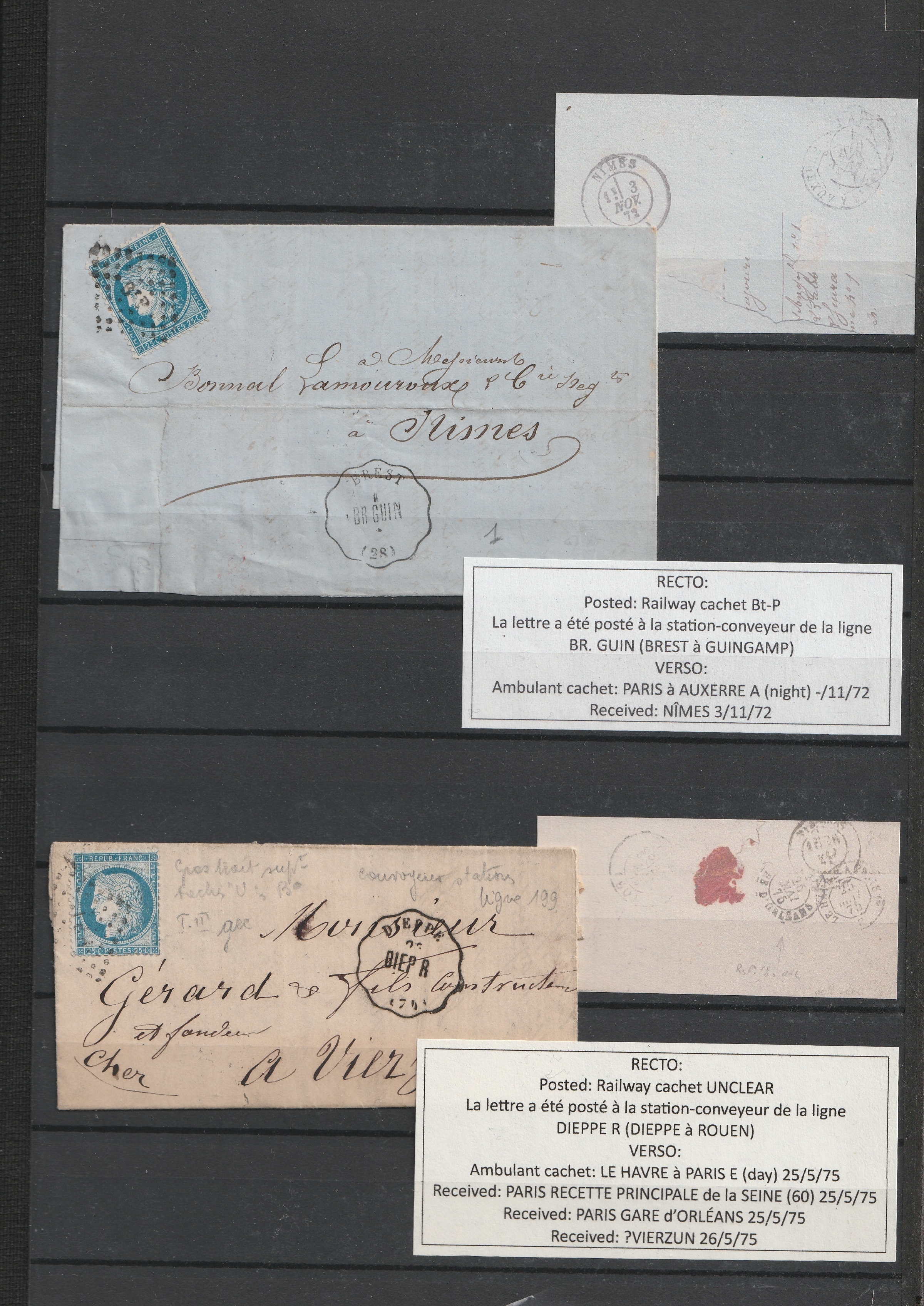
RECTO:
Posted: Railway cachet Bt-P
La lettre a été posté à la station-convoyeur de la ligne
BR. GUIN (BREST à GUINGAMP)
VERSO:
Ambulant cachet: PARIS à AUXERRE A (night) -/11/72
Received: NÎMES 3/11/72
REPUBLIC FRANÇAISE
Gros lisat sujet
Heels U à R
T. III gce
coureyeur station
ligne 199
Monsieur
Gérard & fils construction
et fandeur
Cher
A Vierz
DIEP R
71
RECTO:
Posted: Railway cachet UNCLEAR
La lettre a été posté à la station-convoyeur de la ligne
DIEPPE R (DIEPPE à ROUEN)
VERSO:
Ambulant cachet: LE HAVRE à PARIS E (day) 25/5/75
Received: PARIS RECETTE PRINCIPALE DE la SEINE (60) 25/5/75
Received: PARIS GARE d'ORLÉANS 25/5/75
Received: ?VIERZUN 26/5/75
Anyhtere
Messrs Allen, Hambury & Barry
Plough Court
Lombard Street
E 4 London E.C.
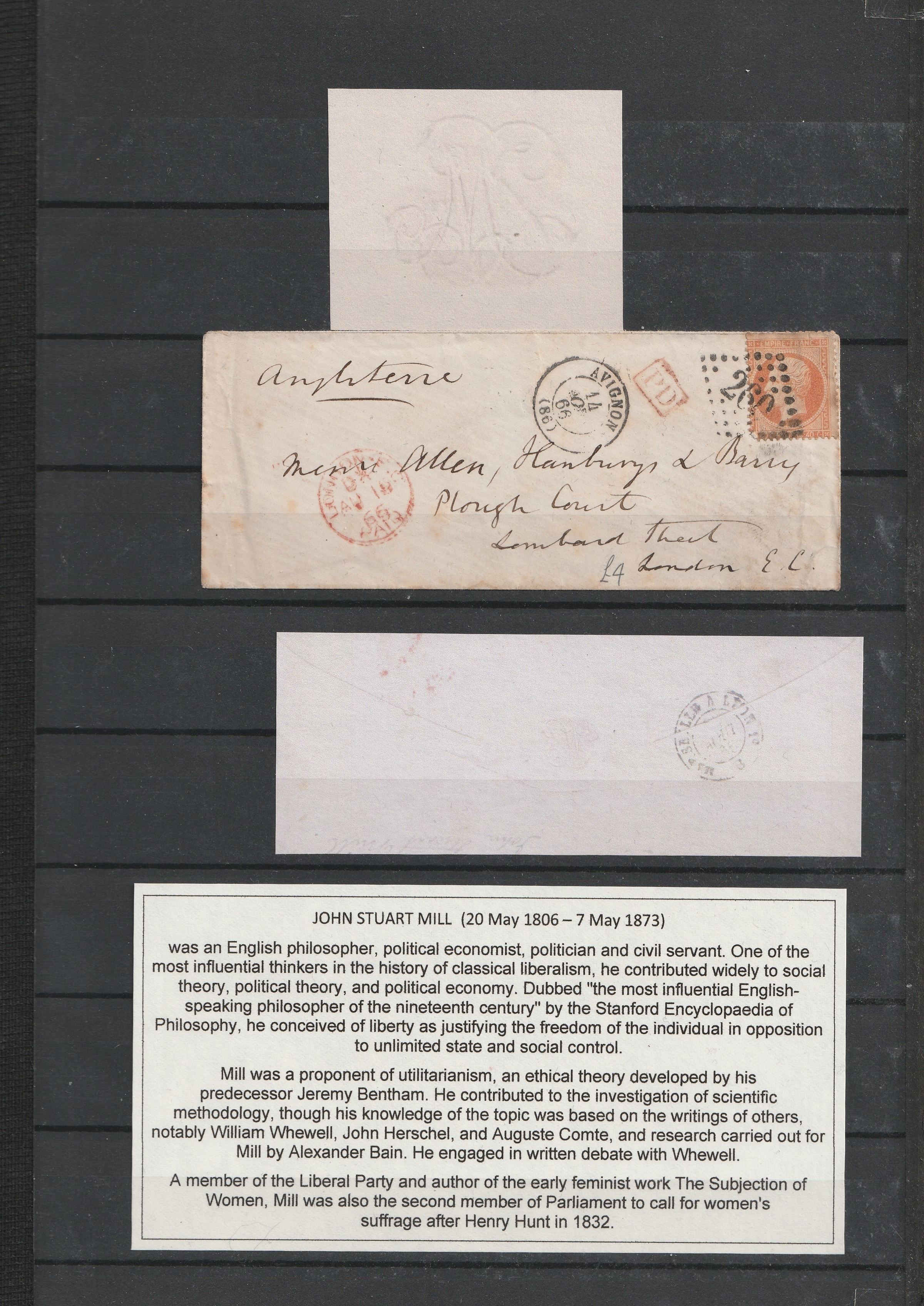
JOHN STUART MILL (20 May 1806 – 7 May 1873)
was an English philosopher, political economist, politician and civil servant. One of the most influential thinkers in the history of classical liberalism, he contributed widely to social theory, political theory, and political economy. Dubbed "the most influential English-speaking philosopher of the nineteenth century" by the Stanford Encyclopaedia of Philosophy, he conceived of liberty as justifying the freedom of the individual in opposition to unlimited state and social control.
Mill was a proponent of utilitarianism, an ethical theory developed by his predecessor Jeremy Bentham. He contributed to the investigation of scientific methodology, though his knowledge of the topic was based on the writings of others, notably William Whewell, John Herschel, and Auguste Comte, and research carried out for Mill by Alexander Bain. He engaged in written debate with Whewell.
A member of the Liberal Party and author of the early feminist work The Subjection of Women, Mill was also the second member of Parliament to call for women's suffrage after Henry Hunt in 1832.