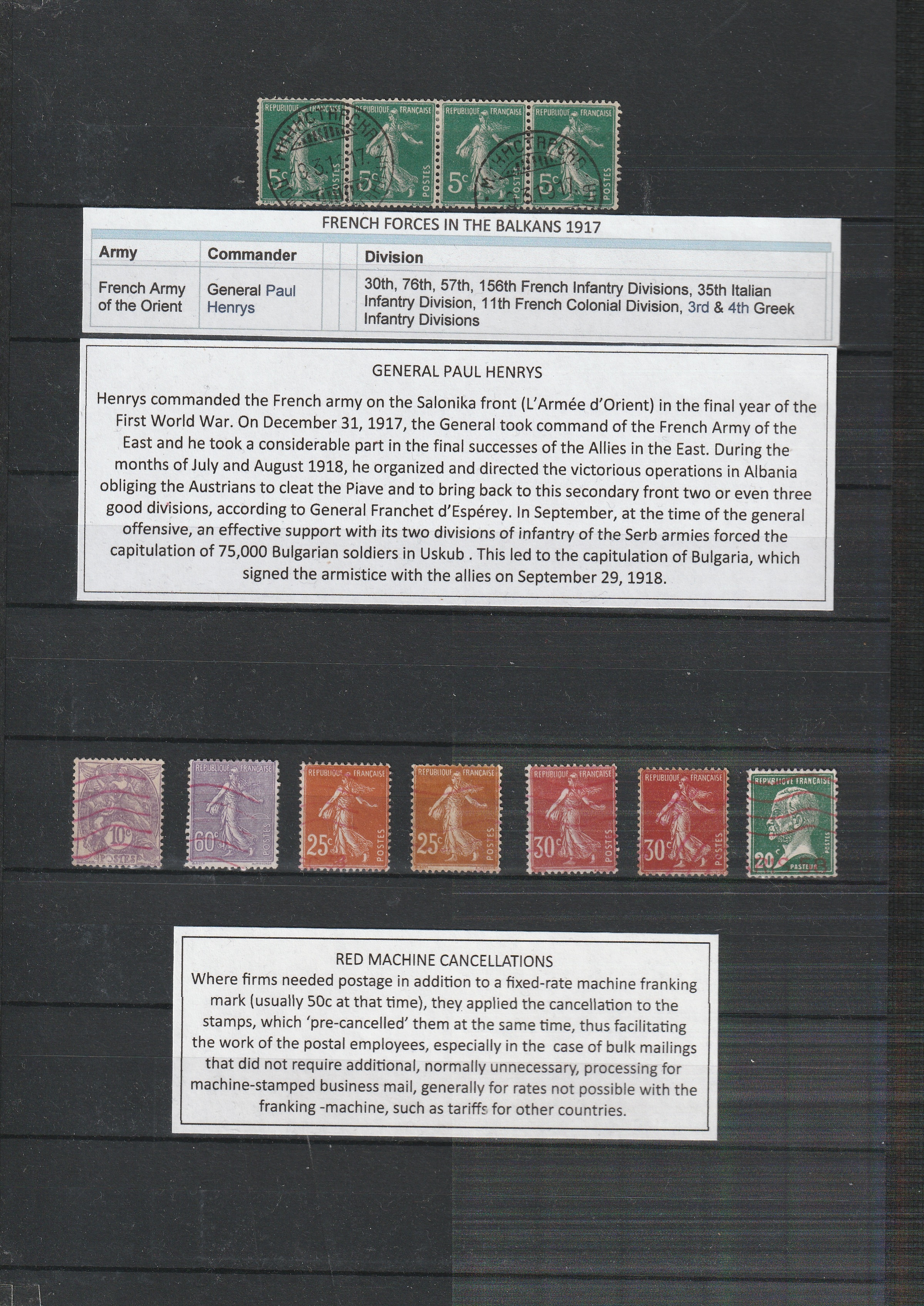
FRENCH FORCES IN THE BALKANS 1917
Army Commander Division
French Army General Paul 30th, 76th, 57th, 156th French Infantry Divisions, 35th Italian
of the Orient Henrys Infantry Division, 11th French Colonial Division, 3rd & 4th Greek
Infantry Divisions
GENERAL PAUL HENRYS
Henrys commanded the French army on the Salonika front (L’Armée d’Orient) in the final year of the
First World War. On December 31, 1917, the General took command of the French Army of the
East and he took a considerable part in the final successes of the Allies in the East. During the
months of July and August 1918, he organized and directed the victorious operations in Albania
obliging the Austrians to cleat the Piave and to bring back to this secondary front two or even three
good divisions, according to General Franchet d’Espérey. In September, at the time of the general
offensive, an effective support with its two divisions of infantry of the Serb armies forced the
capitulation of 75,000 Bulgarian soldiers in Uskub. This led to the capitulation of Bulgaria, which
signed the armistice with the allies on September 29, 1918.
RED MACHINE CANCELLATIONS
Where firms needed postage in addition to a fixed-rate machine franking
mark (usually 50c at that time), they applied the cancellation to the
stamps, which ‘pre-cancelled’ them at the same time, thus facilitating
the work of the postal employees, especially in the case of bulk mailings
that did not require additional, normally unnecessary, processing for
machine-stamped business mail, generally for rates not possible with the
franking -machine, such as tariffs for other countries.
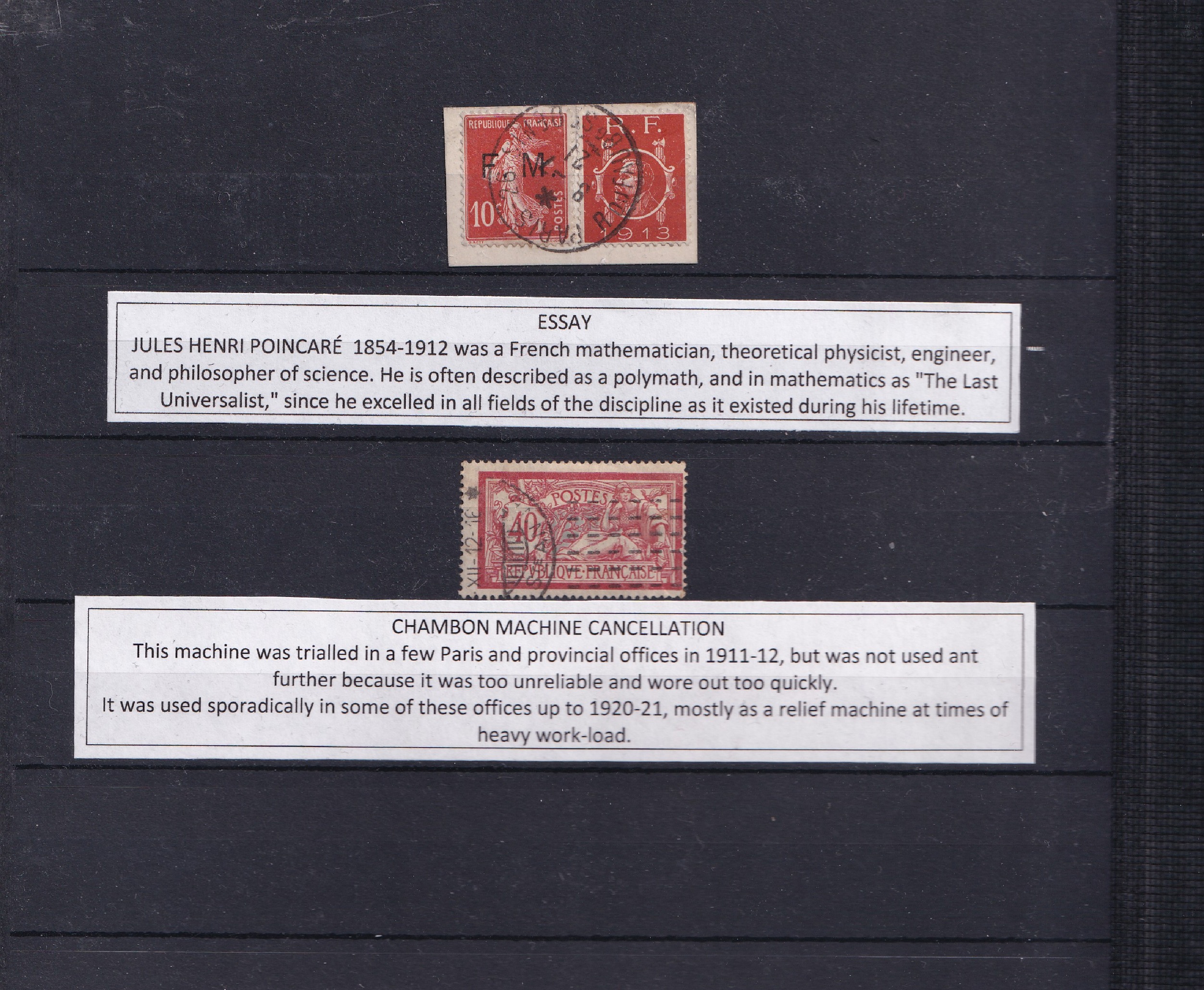
ESSAY
JULES HENRI POINCARÉ 1854-1912 was a French mathematician, theoretical physicist, engineer,
and philosopher of science. He is often described as a polymath, and in mathematics as “The Last
Universalist,” since he excelled in all fields of the discipline as it existed during his lifetime.
CHAMBON MACHINE CANCELLATION
This machine was trialled in a few Paris and provincial offices in 1911-12, but was not used ant
further because it was too unreliable and wore out too quickly.
It was used sporadically in some of these offices up to 1920-21, mostly as a relief machine at times of
heavy work-load.
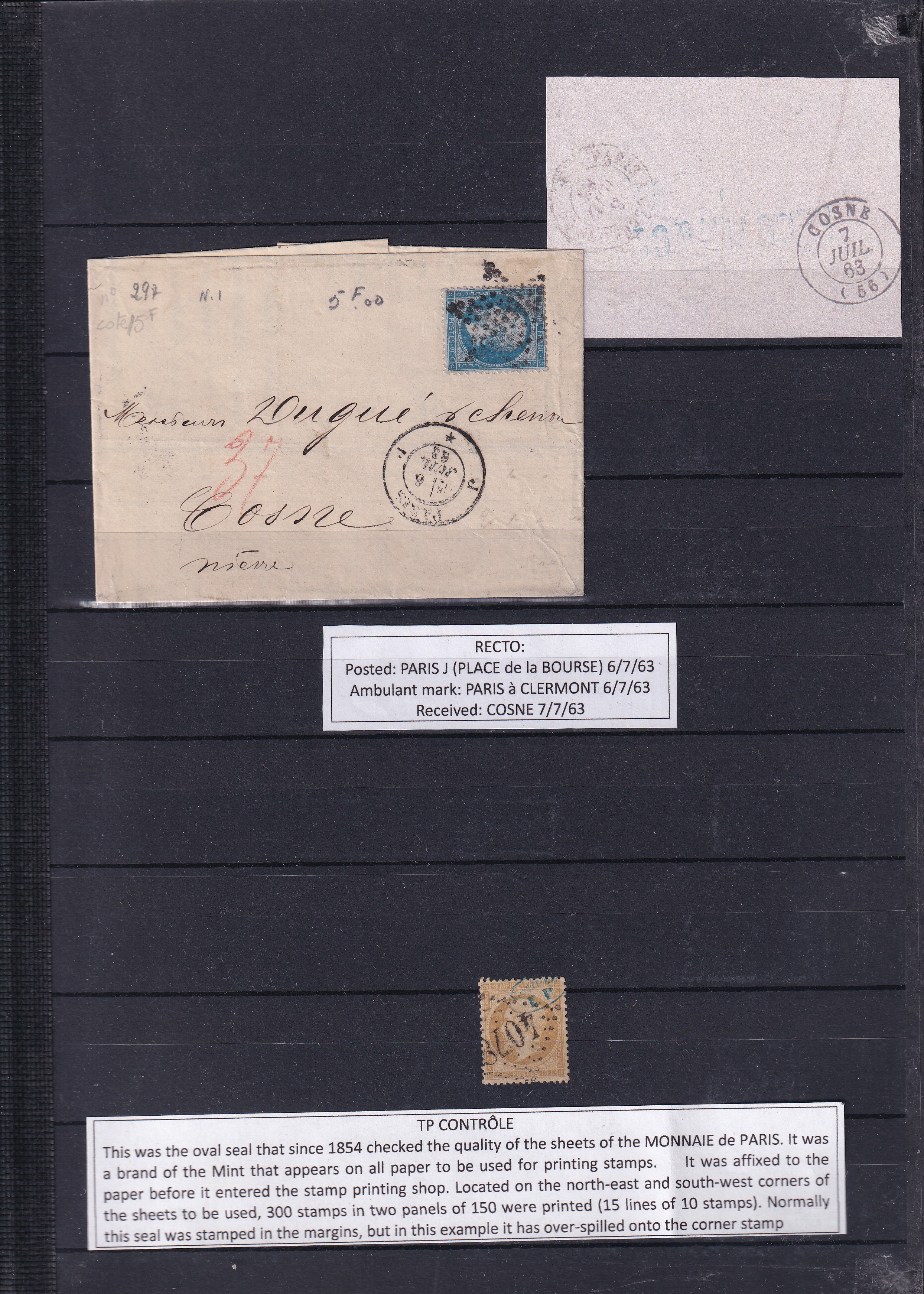
No 297
cote 75 F
N.1
Monsieur Longui’ ocheno
Cosne
nièvre
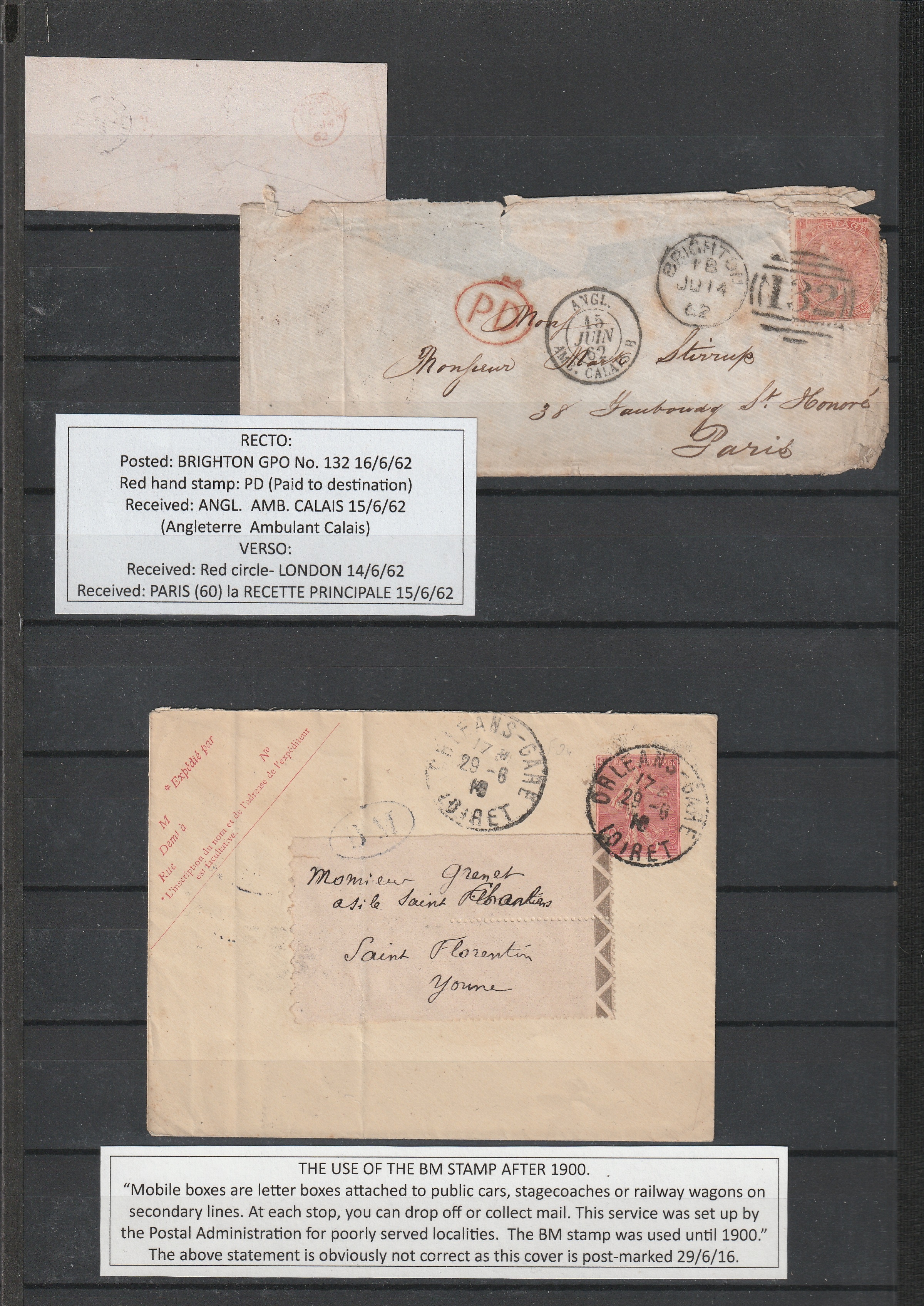
RECTO:
Posted: PARIS J (PLACE de la BOURSE) 6/7/63
Ambulant mark: PARIS à CLERMONT 6/7/63
Received: COSNE 7/7/63
TP CONTRÔLE
This was the oval seal that since 1854 checked the quality of the sheets of the MONNAIE de PARIS. It was a brand of the Mint that appears on all paper to be used for printing stamps. It was affixed to the paper before it entered the stamp printing shop. Located on the north-east and south-west corners of the sheets to be used, 300 stamps in two panels of 150 were printed (15 lines of 10 stamps). Normally this seal was stamped in the margins, but in this example it has over-spilled onto the corner stamp

PREFECTS
A prefect (French: préfet, plural préfets) in France is the state’s
representative in
a department or region. Subprefects (French: sous-préfets) are
responsible for the subdivisions of departments, known
as arrondissements. The office of a prefect is known as
a prefecture and that of a subprefect as a subprefecture.
Regional prefects are ex officio the departmental prefects of
the regional prefecture.
Prefects are tasked with upholding the law in the department
in which they serve, including controlling the actions of local
authorities to ensure adhesion to national guidelines. They are
authorised to sue local collectivities in the name of the state.
Prefects are appointed by a decree of the President of
France when presiding the Government’s Council of Ministers,
following a proposal by the Prime Minister and the Minister of
the Interior. They serve at the Government’s discretion and can
be replaced at any meeting of the Council of Ministers.
The post of prefect was first created on 17 February 1800 by
then-First Consul Napoléon Bonaparte. Their roles were initially
similar to those of the pre-revolutionary intendants. Prefects
were initially charged with supervising local governments in
their department, ensuring that taxes flowed to Paris and
supervising conscription at the local level.
LYON
PREFECTURE
PRINTERS’ WASTE
Printers’ waste generally refers to stamps that appear to be errors but are not, because of their origin. Most
recognized errors are sold over the post office counter and are later sold to dealers or collectors. Printers’ waste,
however, is misprinted material (either by accident or intent) that was intended to be discarded. It is also possible
that printers’ waste was produced as part of the cleaning process, where paper was run through the printing
plates to clean off excess ink. Such material enters the philatelic market through either carelessness or theft.
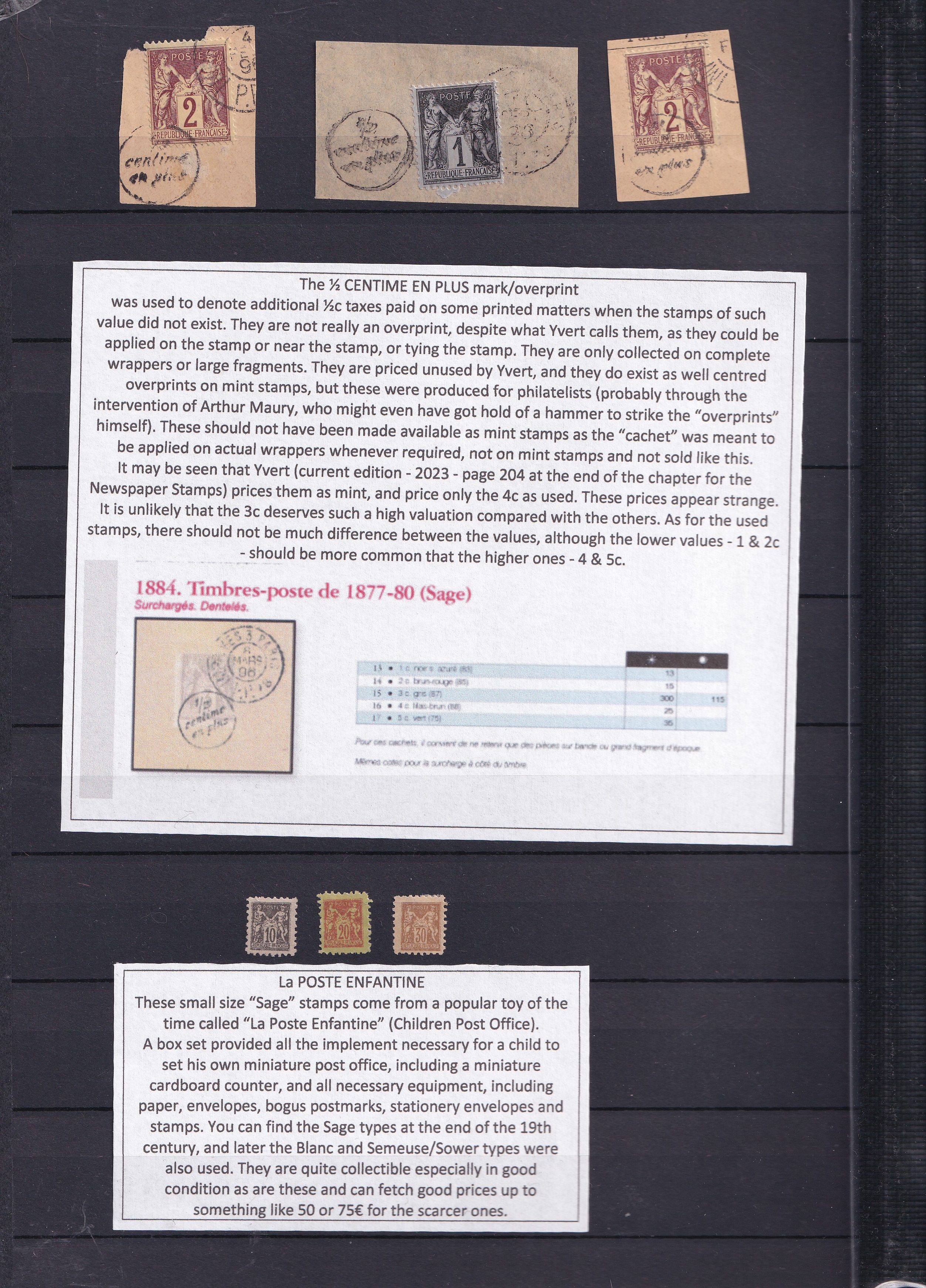
The ½ CENTIME EN PLUS mark/overprint
was used to denote additional ½c taxes paid on some printed matters when the stamps of such
value did not exist. They are not really an overprint, despite what Yvert calls them, as they could be
applied on the stamp or near the stamp, or tying the stamp. They are only collected on complete
wrappers or large fragments. They are priced unused by Yvert, and they do exist as well centred
overprints on mint stamps, but these were produced for philatelists (probably through the
intervention of Arthur Maury, who might even have got hold of a hammer to strike the “overprints”
himself). These should not have been made available as mint stamps as the “cachet” was meant to
be applied on actual wrappers whenever required, not on mint stamps and not sold like this.
It may be seen that Yvert (current edition – 2023 – page 204 at the end of the chapter for the
Newspaper Stamps) prices them as mint, and price only the 4c as used. These prices appear strange.
It is unlikely that the 3c deserves such a high valuation compared with the others. As for the used
stamps, there should not be much difference between the values, although the lower values -1 & 2c
– should be more common that the higher ones – 4 & 5c.
1884. Timbres-poste de 1877-80 (Sage)
Surchargés. Dentelés.
La POSTE ENFANTINE
These small size “Sage” stamps come from a popular toy of the
time called “La Poste Enfantine” (Children Post Office).
A box set provided all the implement necessary for a child to
set his own miniature post office, including a miniature
cardboard counter, and all necessary equipment, including
paper, envelopes, bogus postmarks, stationery envelopes and
stamps. You can find the Sage types at the end of the 19th
century, and later the Blanc and Semeuse/Sower types were also used. They are quite collectible especially in good
condition as are these and can fetch good prices up to
something like 50 or 75€ for the scarcer ones.