
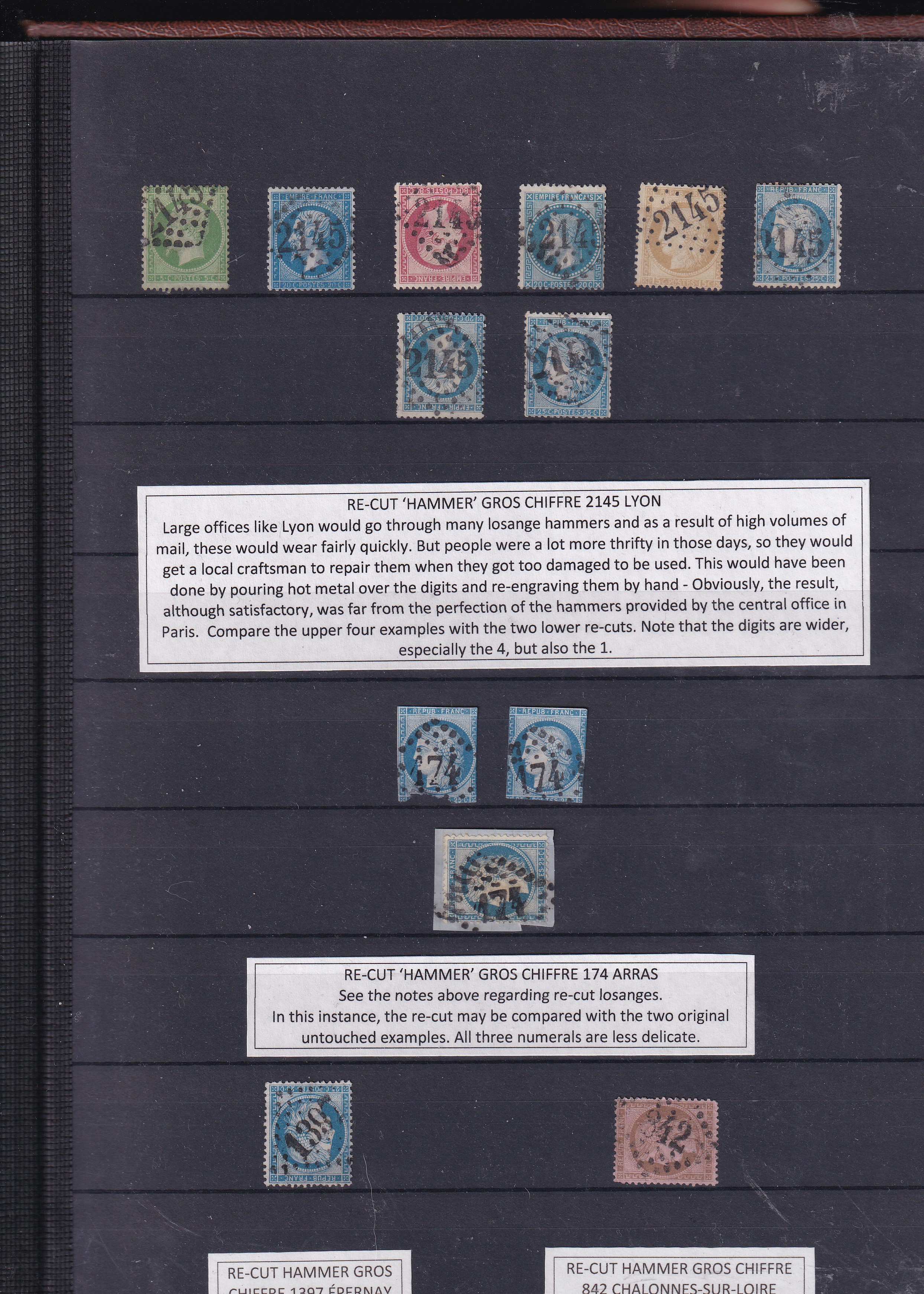
RE-CUT 'HAMMER' GROS CHIFFRE 2145 LYON Large offices like Lyon would go through many losange hammers and as a result of high volumes of mail, these would wear fairly quickly. But people were a lot more thrifty in those days, so they would get a local craftsman to repair them when they got too damaged to be used. This would have been done by pouring hot metal over the digits and re-engraving them by hand - Obviously, the result, although satisfactory, was far from the perfection of the hammers provided by the central office in Paris. Compare the upper four examples with the two lower re-cuts. Note that the digits are wider, especially the 4, but also the 1. RE-CUT 'HAMMER' GROS CHIFFRE 174 ARRAS See the notes above regarding re-cut losanges. In this instance, the re-cut may be compared with the two original untouched examples. All three numerals are less delicate. RE-CUT HAMMER GROS RE-CUT HAMMER GROS CHIFFRE 22 CHALONNES-SUR-LOIRE
The word "DEPART" associated with the date stamp. This is basically to indicate at what stage of the postal treatment the date stamp has been applied, and thus to establish exactly when the item has officially entered the postal system. It shows at what time the item was sent on its way for dispatch to its destination. It was very important at the time to establish exactly at what time a lettre would leave the office of origin (in English it might be phrased "when the letter departs the office of origin"), at what time it would pass by various offices in transit (including TPOs), at what time it would arrive at the office of destination ("ARRIVÉE") and at what time it would be taken for delivery ("DISTRIBUTION"). Thus the multiple hand stamps. The hand stamps with "DEPART" were specifically used to indicate the date and time of departure from the office of origin. The same was frequently used by most continental countries postal administrations ("AUSGABE" on German, Swiss or Austrian date stamps for instance, and the equivalent in most other countries). It appears that the date stamps with "DEPART" were only used in large offices. Obviously small offices would not differentiate - In fact the indication probably means that it came from an office where volumes were large enough for the office to have separate sections dealing with departing mails, arriving mails and distribution ("DÉPART", "ARRIVÉE" & "DISTRIBUTION") with dedicated clerks (and date stamps) in each section. Thus this would apply in large offices only - so, not only the "RECETTE PRINCIPALE" but also other large offices in Paris, and mostly the Recettes Principales in the provinces.